
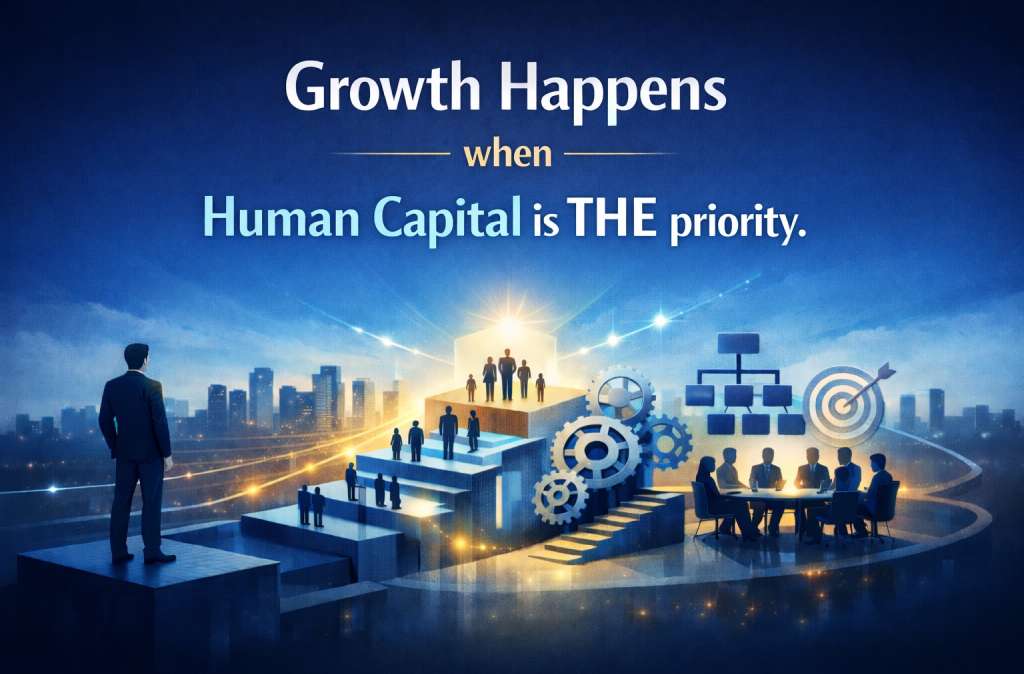
Growth Happens when Human Capital is THE priority
Profitable growth doesn’t break because of strategy. It breaks because leadership capacity doesn’t scale.
Most of my career has been spent operating or helping businesses with ~$10M in annual revenue to >$1B, grow and scale successfully.
And most growth plans fail for one reason: the company outgrows its people systems.
Across a diverse set of industries, I note the same advantage present in the companies that sustain profitable growth:
They treat people and leadership the way they treat product, finance, and go-to-market—by building a scalable architecture, not just hiring more people. While many companies upgrade their tech stacks before they upgrade leadership infrastructure, top performing firms prioritize both in tandem.
Different growth stages require different energy for the organization. And what works at one chapter doesn’t automatically translate to the next.
Here’s a practical way to think about where the “human capital system” typically needs to evolve:
$1M → $25M | From scrappy to scalable
Early teams win with versatility and speed. As complexity rises, clarity matters more: roles, decision rights, and your first true functional leaders are identified.
$25M → $100M | The manager build-out
This is where execution starts to depend on layers of leadership. The work isn’t just “who are our stars?”—it’s “how do we consistently develop managers who can run teams, create accountability, and scale culture?”
$100M → $500M | Operating cadence + governance that elevates performance
You don’t need bureaucracy. You do need repeatable operating rhythms: planning, performance management, cross-functional prioritization, and succession thinking—just enough structure to improve decision quality and speed.
$500M → $1B | From hiring leaders to producing leaders
At this scale, the differentiator is bench strength and internal development. If leadership capability isn’t being built 1,2 or 3 levels deep, growth becomes fragile—because execution becomes too dependent on a few people. The growth trajectory experienced to date is running on borrowed time.
What breaks down at $25M, $100M, and $500M is rarely market fit—it’s the operating cadence and leadership depth.
The through-line is simple:
Sustained growth requires continuity and discipline—and those come from intentional systems for talent and leadership.
Think of this as your Human Capital Architecture: the evolving set of practices that ensures you can attract, develop, deploy, and retain leadership capacity as the business scales.
And the key is timing.
The best teams don’t wait for a break to “fix HR.” They design the next version of the people system before the business outgrows the current one. The hidden lever of continuity and discipline is simple: design the people system like you design the business.
After years in operating roles, I now do this work from the advisory side at Corsica Partners—helping CEOs and boards build leadership systems for the next stage of growth, not just backfill roles. We spend as much time discussing talent upgrades and leadership coaching for development as we do on the backfill for voluntary or involuntary attrition.
Boards and CEOs should be asking themselves these questions and reviewing the answers quarterly:
Will our talent and leadership systems keep pace with the business—or are we expecting yesterday’s model to carry tomorrow’s complexity?
Is our leadership bench compounding or thinning?
And if they are sponsors of founder led businesses, face reality. If the CEO is still the operating system, the company will not scale according to your thesis.
I’ve come to value these truths:
- The most expensive scaling mistake isn’t a bad hire—it’s having no bench.
- Profitable growth doesn’t break because of strategy. It breaks because leadership capacity doesn’t scale.
- At every stage of growth, the constraint is the same: leadership competency and capacity.
And growth continuity isn’t luck. It’s designed—and executed through a disciplined Human Capital Architecture.


