Range Players vs. Tournament Players

Spend enough time around golf and you learn an important truth:

The driving range can be dangerously misleading.

Everyone looks good on the driving range.

The swing is smooth. The ball flight is perfect. Every shot sounds pure.

Then the tournament starts.

The pressure changes. The crowd shows up. Decisions matter more. And suddenly, not everyone performs the same way.

Business – especially in private equity-backed environments – works similarly.

Some executives interview exceptionally well. They communicate in polished frameworks, tell compelling stories, and know exactly how to command a room.

But operating performance is something entirely different…

-Can they lead through ambiguity?
-Can they make difficult decisions with incomplete information?
-Can they earn followership when conditions tighten?
-Can they maintain composure when growth slows, margins compress, or the board starts asking harder questions?

That’s tournament golf.

At the highest levels of leadership, the gap is rarely intelligence or experience alone. It is the ability to execute consistently under pressure.

The best investors and boards understand this distinction.

They are not hiring for the range.

They are hiring for Sunday afternoon.

Corsica Partners Quarterly Brief Q2 2026

Corsica Partners

Q2 2026 | Talent Insights and Perspective

The Corsica Partners’ Quarterly Brief brings together timely insights for executives, investors, and boards navigating growth, transformation, and talent acquisition and retention priorities.

This brief is prepared for our clients, candidates and business partners and it reflects what we are seeing, hearing, and learning from the highest-performing companies, most admired leaders, and most successful financial sponsors across the market.

Each edition distills those observations into concise perspectives on the leadership and talent dynamics that are defining competitive advantage right now. We share these insights in the spirit in which they are offered, as trusted advisors committed to the success of the leaders and organizations, we are proud to serve.
The conversation about AI and the future of work has reached peak noise. Competing headlines tell us everything and nothing at once: AI creates abundance; AI eliminates jobs; AI is overhyped; AI is underestimated. All of them, in their own way, are correct. But for the leaders and organizations we serve, the more important question is not what AI does — it is who is equipped to lead through it.

That question has a sharper edge than it appears.

The Structural Shift

Futurist Peter Diamandis has written compellingly about what he calls the “organizational singularity”—the moment when one person paired with AI can execute what once required teams of fifty or one hundred. The transaction costs that made the traditional corporation necessary are collapsing. Functions that required headcount, overhead, and coordination are increasingly automated. Diamandis identifies two emerging classes: orchestrators, who direct AI systems with strategic intent, and the displaced, who wait for structures that no longer exist to carry them forward.

This framing is useful. It is also incomplete because orchestration is not a technology skill. It is a leadership skill. And leadership skills are exactly what our clients are trying to hire, develop, and retain right now.

“AI automates tasks, but building human leadership remains essential for strategy, sound judgment, and creative thinking — capabilities that provide an irreplaceable competitive edge.” ~MCKINSEY & COMPANY

What We Are Seeing

The pace of change continues to accelerate, and even those who believe they are first movers know it takes but a day to fall behind. In that environment, practical experience is at a premium. And where experience is absent, hesitation fills the gap.

We see it in candidates uncertain about what their next role will demand of them — and whether their current capabilities translate. We see it in clients struggling to define what AI-fluent leadership looks like beyond the buzzword, and how to assess it in a search process. And we see it across the search industry itself, navigating an advisory function that is itself being transformed.

Our view is direct: meet talent where they are. Not with hype. Not with alarm. With practical guidance grounded in what we are observing across diverse sectors, and what it is changing about leadership profiles.

The companies positioned to lead their sectors three years from now are building AI capability into every function today. That makes every executive hire a higher-stakes decision than it was in the previous cycle. The leaders hired in this window will either accelerate transformation or become the constraint on it. There is diminishing middle ground.

What Good Looks Like

The capabilities that matter most in this environment are not found on a technology vendor’s feature list. They are profoundly human — and more differentiated than ever precisely because they cannot be replicated at scale.

Critical thinking
Owns their analysis. Resists the pull of consensus and the seduction of easy answers.

Situational awareness
Reads the room — the organization, the market, the moment — and calibrates accordingly.

Systems thinking
Sees second-order effects. Understands how decisions ripple before they act.

Calm amid hype
Neither seduced by possibility nor paralyzed by disruption. Grounded and clear-eyed.

Resolve under uncertainty
Moves forward without full information. Makes the call. Adjusts without ego.

AI fluency
Not mastery of tools — but literacy in possibility and judgment about application.

These are the attributes we are screening for across every engagement. They are also the attributes that will determine whether AI becomes a force multiplier or a drag on enterprise value.

The CP Perspective

We are not in the business of predicting when AI peaks or plateaus. We are in the business of finding the leaders who perform through whatever comes next.

The organizational structures described in the current discourse — leaner, faster, more agentic — are real and they are arriving. But they do not run themselves. They require orchestrators who possess strategic judgment, the capacity for genuine creative synthesis, and the relational trust that neither a language model nor an agent fleet can manufacture.

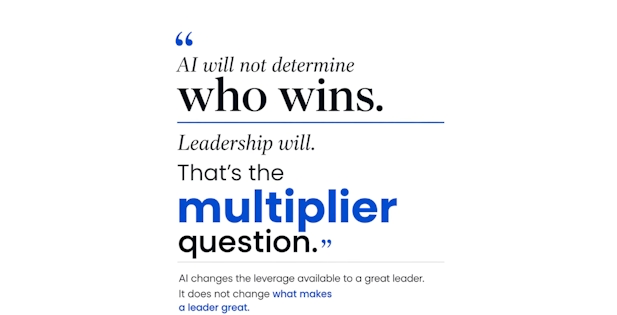
AI changes the leverage available to a great leader. It does not change what makes someone one.

In a moment defined by noise, the ability to think clearly and act with conviction is the scarcest resource in any organization. That is what we are searching for. It is what we deliver for our clients.
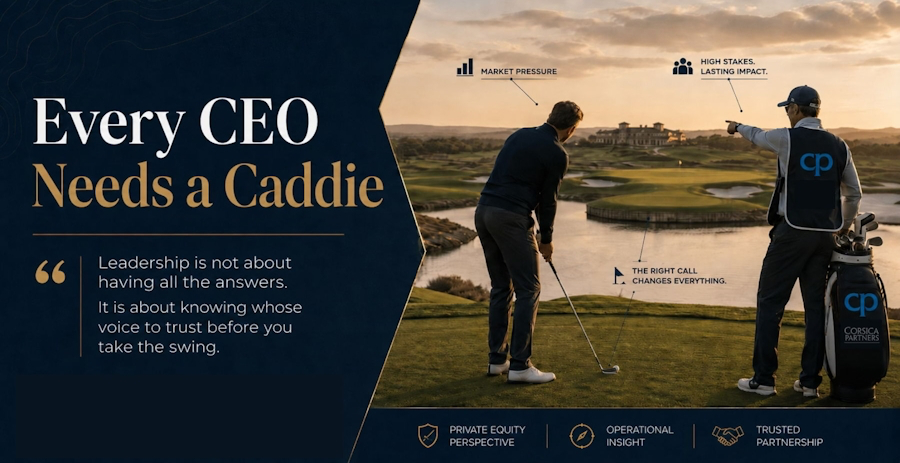
One of the great myths of golf is that it is an individual sport.

Sure, there is only one player holding the club. But spend five minutes watching a major championship and you’ll see the truth: the player may hit the shot, but the caddie is never far from the decision.

They are part strategist, part psychologist, part meteorologist, part truth-teller.

The best caddies know when to encourage, when to challenge, and when to quietly remove the driver from the conversation.

The same is true in business.

A CEO may be the one standing over the ball, but the best ones are rarely operating alone. They have people around them who help read the terrain: board members, investors, operating partners, CFOs, chiefs of staff, and trusted advisors who can see what pressure sometimes distorts.

That matters even more in private equity.

The course is shorter. The expectations are higher. The hazards are everywhere. And nobody wants to explain to the board why they tried to carry the water with a 3-wood when a sensible layup would have done just fine.

Great CEOs need conviction.

But they also need counsel.

They need people who can help them separate confidence from ego, urgency from panic, and boldness from recklessness.

Because leadership is not about having all the answers.

It is about knowing whose voice to trust before you take the swing.

Straight Talk from the C-Suite
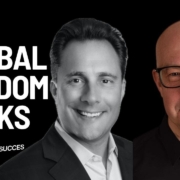
AI in the Enterprise.

Host: Dan Veitkus, Managing Partner, Corsica Partners

A conversation with Inna Kuznetsova, an award winning, 3x CEO for PE backed, global SaaS and AI companies, recognized as a top Tech CEO and top female executive in the supply chain industry and an active board member for global public and private companies.

Introduction

The discussion around AI in the enterprise has moved well past strategy decks and board presentations. It is now reshaping how executives lead, how organizations hire, and how the most forward-thinking companies are defining leadership itself. In this edition of our Straight Talk from the C-Suite series, I sat down with Inna Kuznetsova, a C-suite leader who is navigating that transformation from the front lines, bringing her perspective on what AI means for her work, her team, and the talent decisions that will define the next chapter of her organization. This conversation touched on leadership in the age of intelligent machines, and what it takes to be irreplaceably human.

AI & Personal Work Patterns

Walk me through a typical week — where has AI genuinely changed how you personally work, and where do you still insist on human judgment above all else?

AI has compressed the time I spend on synthesis, research, and first-draft work. But I keep human judgment for prioritization, tradeoffs, even the tone of communications for each particular case.

What’s the most unexpected way AI has shown up in your personal workflow in the last year — something that would have surprised even your 2025 self?

As a non-work example, I set an agent to distill news from dozens of news sites in multiple languages, foes and allies, on Iran war to just facts and numbers, while removing the political opinions. So, getting up to speed in a more objective way took just seconds every morning. A more refined way of AI use was writing an application allowing me to add comments to networking records, and this is by someone who has not coded since Harry met Sally.

AI Shaping the Operating Environment

Private equity investors and board-level stakeholders are watching how leadership teams operationalize AI — what does ‘getting it right’ actually look like inside your organization, in concrete terms?

Teams that win treat AI as process redesign, not a tool rollout. I am very supportive of spending a bit on experiments, allowing everyone in the organization to test what they can do and come up with solutions. People who are the closest to the workflow, e.g. implementation team spending hours on data quality or setting customer’s analytics process often come up with the most practical ways to cut time. However, when it comes to a full organizational rollout the measurable productivity gain in core workflows, and controlled risk through clear policies on data, validation, and human checkpoints are important.

Testing for AI Acumen in Executive Recruiting

When you’re evaluating a C-suite or senior leadership candidate, how do you distinguish between someone who genuinely understands and applies AI versus someone who has simply learned to speak the language?

I ask them to walk me through a specific problem they solved differently because of AI no matter how small. People who actually use it can get granular immediately; people who’ve learned the language tend to stay abstract and pivot to strategy. If you vibed a small app or ran a company valuation model together with research on multiples, you will be able to answer the clarifying questions, that is what you did not like in the first draft and how you corrected it.

The Human Value Proposition

As AI assumes more of the cognitive load, what uniquely human qualities are you doubling down on — in yourself, and in the leaders, you recruit and develop?

People who are successful in the AI era think as architects, not coders. I double down on why a certain problem was selected, check for judgment under ambiguity, taste, and accountability. AI makes us leaders before we are ready to lead. So, I look for the ability to frame problems well, set a high-quality bar, approach the answers critically and align people around actions.

What is the one quality you’ve observed in your highest-performing leaders that no AI tool has come close to replicating — and how do you deliberately screen for it when building your team?

Initiative, sound judgment, ownership of hard decisions, and honest reflection are among the most valuable human leadership traits. I look for leaders who can tell me about a moment when they surprised others with a thoughtful strategic move, as well as a time when they looked back on a successful project and still saw a better way it could have been done. Self-awareness is uniquely human and an attribute I prioritize when vetting candidates.

Outlook for the Balance of 2026

If you could prompt your peers in the C-suite right now, something you wish more leaders were paying attention to heading into the back half of the year, what would it be?

Buying Copilot licenses is not an AI strategy. Take one proven use case an employee is already doing and scale it across the function quickly; start small, move fast, because the market is not waiting.

Straight Talk Summary

AI acumen is a required leadership attribute, and the most successful leaders are learning, challenging, recalibrating and pressing forward in real time.

At Corsica Partners, we see this dynamic every day. The organizations pulling ahead are not simply adopting AI tools. They are asking harder questions about the humans deploying them — their judgment, their adaptability, and their capacity to lead through ambiguity without losing their footing.

What distinguishes the executives we most respect — and most frequently place — is not their fluency with technology alone. It is their clarity of thought, their integrity under pressure, and their instinct for what matters when everything is moving at once. Those qualities do not appear on a dashboard. They reveal themselves in the decisions leaders make when the stakes are real.

That is the conversation Corsica Partners is built to facilitate — with investors, boards, and executives who understand that exceptional talent remains the most durable competitive advantage in any market, in any cycle.
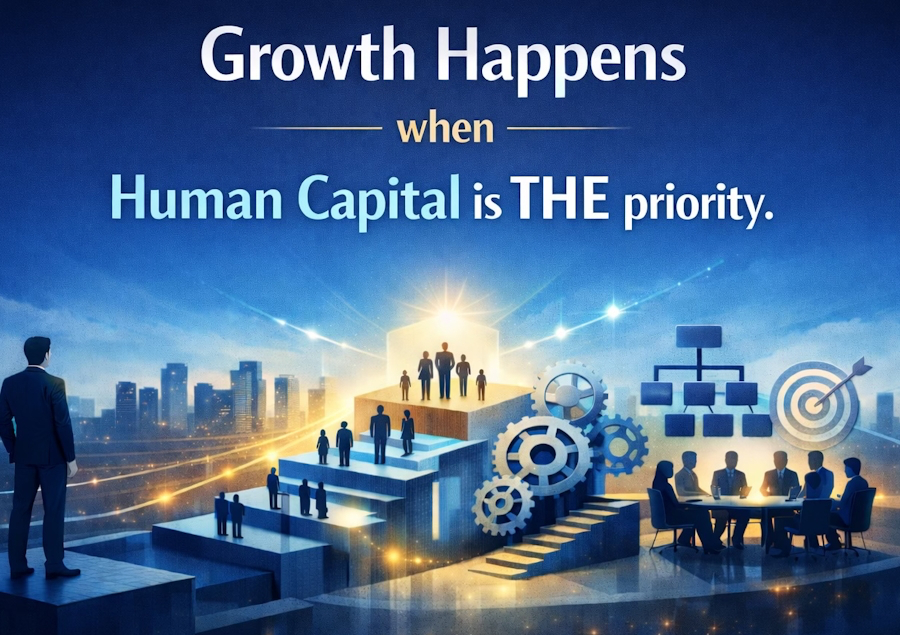
Across a diverse set of industries, we note the same advantage present in the companies that sustain profitable growth:

They treat people and leadership the way they treat product, finance, and go-to-market—by building a scalable architecture, not just hiring more people.

While many companies upgrade their tech stacks before they upgrade leadership infrastructure, top performing firms prioritize both in tandem.

What breaks down at $25M, $100M, $500M & >$1B is rarely market fit. It’s the operating cadence and leadership depth.

The through-line is clear:

Sustained growth requires continuity and discipline and those come from intentional systems for talent and leadership.

Think of this as your Human Capital Architecture: the evolving set of practices that ensures you can attract, develop, deploy, and retain leadership capacity as the business scales.

Boards and CEOs should be asking themselves these questions and reviewing the answers quarterly:

  • Will our talent and leadership systems keep pace with the business—or are we expecting yesterday’s model to carry tomorrow’s complexity?
  • Is our leadership bench compounding or thinning?

And if they are sponsors of founder-led businesses, face reality. If the CEO is still the operating system, the company will not scale according to your thesis.

Take this experience to heart:

The most expensive scaling mistake isn’t a bad hire—it’s having no bench.

Profitable growth doesn’t break because of strategy. It breaks because leadership capacity doesn’t scale.

At every stage of growth, the constraint is the same: leadership competency and capacity.

And growth continuity isn’t luck. It’s designed—and executed through a disciplined Human Capital Architecture.

  • CEO, private equity backed, managed IT services
  • CEO, privately held, AI powered SaaS, analytics & logistics
  • President, private equity backed, wealth management company
  • CFO, private equity backed, SaaS company
  • Head of AI, privately held, multi-site healthcare services provider
  • Head of AI, family office, HoldCo
  • CCO, private equity backed, life sciences company
  • SVP Sales, private equity backed, biotech company
  • Chief Product Officer (CPO), privately held, GRC SaaS platform
  • Non-Executive Board Member, life sciences company

Experience the Corsica Advantage™

Corsica Partners serves as a trusted, boutique executive search firm to discerning investors, their portfolio of companies and leading public companies across technology, tech-enabled services, healthcare and life sciences.

We offer the following services to clients:

* Retained, Executive Search
* C-Suite Talent Pipeline Development
* Executive Coaching and Growth Advisory Services

Whether your profile is early stage, high growth, turnaround or you’re at the crossroads of a transformation or you simply desire to experience a better executive search and coaching outcome, we invite you to put the Corsica Advantage™ to work for you.

For more information, please contact us at info@corsicateam.com or +1.941.444.9617

Growth Happens when Human Capital is THE priority

Profitable growth doesn’t break because of strategy. It breaks because leadership capacity doesn’t scale.

Most of my career has been spent operating or helping businesses with ~$10M in annual revenue to >$1B, grow and scale successfully.

And most growth plans fail for one reason: the company outgrows its people systems.

Across a diverse set of industries, I note the same advantage present in the companies that sustain profitable growth:

They treat people and leadership the way they treat product, finance, and go-to-market—by building a scalable architecture, not just hiring more people. While many companies upgrade their tech stacks before they upgrade leadership infrastructure, top performing firms prioritize both in tandem.

Different growth stages require different energy for the organization. And what works at one chapter doesn’t automatically translate to the next.

Here’s a practical way to think about where the “human capital system” typically needs to evolve:

$1M → $25M | From scrappy to scalable
Early teams win with versatility and speed. As complexity rises, clarity matters more: roles, decision rights, and your first true functional leaders are identified.

$25M → $100M | The manager build-out
This is where execution starts to depend on layers of leadership. The work isn’t just “who are our stars?”—it’s “how do we consistently develop managers who can run teams, create accountability, and scale culture?”

$100M → $500M | Operating cadence + governance that elevates performance
You don’t need bureaucracy. You do need repeatable operating rhythms: planning, performance management, cross-functional prioritization, and succession thinking—just enough structure to improve decision quality and speed.

$500M → $1B | From hiring leaders to producing leaders
At this scale, the differentiator is bench strength and internal development. If leadership capability isn’t being built 1,2 or 3 levels deep, growth becomes fragile—because execution becomes too dependent on a few people. The growth trajectory experienced to date is running on borrowed time.

What breaks down at $25M, $100M, and $500M is rarely market fit—it’s the operating cadence and leadership depth.

The through-line is simple:

Sustained growth requires continuity and discipline—and those come from intentional systems for talent and leadership.

Think of this as your Human Capital Architecture: the evolving set of practices that ensures you can attract, develop, deploy, and retain leadership capacity as the business scales.

And the key is timing.

The best teams don’t wait for a break to “fix HR.” They design the next version of the people system before the business outgrows the current one. The hidden lever of continuity and discipline is simple: design the people system like you design the business.

After years in operating roles, I now do this work from the advisory side at Corsica Partners—helping CEOs and boards build leadership systems for the next stage of growth, not just backfill roles. We spend as much time discussing talent upgrades and leadership coaching for development as we do on the backfill for voluntary or involuntary attrition.

Boards and CEOs should be asking themselves these questions and reviewing the answers quarterly:

Will our talent and leadership systems keep pace with the business—or are we expecting yesterday’s model to carry tomorrow’s complexity?

Is our leadership bench compounding or thinning?

And if they are sponsors of founder led businesses, face reality. If the CEO is still the operating system, the company will not scale according to your thesis.

I’ve come to value these truths:

  • The most expensive scaling mistake isn’t a bad hire—it’s having no bench.
  • Profitable growth doesn’t break because of strategy. It breaks because leadership capacity doesn’t scale.
  • At every stage of growth, the constraint is the same: leadership competency and capacity.

And growth continuity isn’t luck. It’s designed—and executed through a disciplined Human Capital Architecture.

Succession Planning: Event or Renewal?

Dan Veitkus, Managing Partner, Corsica Partners joins Jan Petke, Managing Partner C100, the global private office for UHNW and sovereign family offices to answer this question and confirm best practices for succession planning.

Sell the Stock!

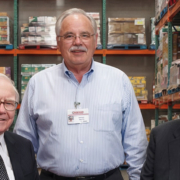
Charlie Munger’s final request wasn’t about family or legacy. In fact, it was so outrageous Warren Buffett replied: “Shoot me first.” Here’s the true story (a masterclass in maximizing shareholder value, long-term) ↓

We have all watched countless executives cave when Wall Street demands lower wages and cut benefits. Costco’s founder faced this exact pressure.

A Deutsche Bank analyst once pointed out that “at Costco, it’s better to be an employee or a customer than a shareholder.”

The implication was damning: the company cared more about workers than investors.

Founder Jim Sinegal heard the criticism.

His response? Three words:

“Sell the stock.”

That’s it. No apology. No compromise. No adjustment to “balance stakeholder interests.”

Why? Because valuing employees is much more than a mere policy in Costco’s handbook. It’s a core value Sinegal will die on a hill for.

But here’s what that Deutsche Bank analyst got completely wrong (as validated by the stock performance over the last 30 years):

This ruthless commitment to principles isn’t bad for shareholders. It’s the best thing that could happen to them.

Enter Charlie Munger.

The legendary investor — Warren Buffett’s business partner for 60+ years — couldn’t disagree more with the Deutsche Bank analyst. Costco was Charlie’s absolute favorite stock.

In fact, when Warren and Charlie were once asked what they would want as their last wish if they were on a plane being hijacked, here’s what they said:

The hijackers offered each one final request before they were executed.

They turned to Charlie first.

Charlie said: “I would like to give once more my speech on the virtues of Costco… with illustrations.”

The hijacker found this so reasonable he granted it.

Then the hijacker turned to Warren: “And what would you like, Mr. Buffett?”

Warren said: “Shoot me first.”

This joke – told by Buffett – perfectly captures the depth of Charlie’s obsession. But it also reveals something profound: the man who understood investing and long-term value creation better than most, chose to stake his reputation and fortune on Costco’s model:

A model that prioritizes employees over quarterly earnings.

A model that ruthlessly puts the company’s core principles first.

The reason Charlie wasn’t delusional is simple: he was thinking in decades while that Deutsche Bank analyst was thinking in quarters.

Costco created a “Code of Ethics” that ranked priorities explicitly:

1. Obey the law

2. Take care of customers

3. Take care of employees

4. Respect suppliers

5. Reward shareholders

Sinegal refused Wall Street’s relentless pressure to cut wages, reduce benefits, or lower employee quality of life to boost quarterly earnings.

During the 2008 financial crisis, when executives discovered nine Costco employees had lost their homes to foreclosure, Sinegal’s response wasn’t to reduce wages to protect profits. Instead, the company maintained its culture of integrity. They treated employees with the same standards they treated customers and suppliers.

Munger once said (about Cosco): “It has a frantic desire to serve customers a little better every year. When other companies find ways to save money, they turn it into profit. Sinegal passes it on to customers. It’s almost a religious duty. He’s sacrificing short-term profits for long-term success.”

The results speak for themselves…

Costco maintained industry-leading employee retention rates. Their employees earned substantially more than retail competitors.

Yet the company’s stock significantly outperformed the broader market over decades — proving that employee-centric values aren’t a cost to profit, they’re the very engine that powers profit.

Sinegal said it simply: “It’s easy. We all know what the right thing to do is.”

When you actually do the right thing — and hold firm through the pressure — your organization becomes something your competitors can never replicate.

The competitors obsessing over margin expansion (easily copied) never had the moat that Costco built.

The competitors squeezing employees and customers never create the loyalty that generates predictable, rising profits for decades.

Don’t be tempted to think this only applies to Fortune 500 companies.

Whether public or private these are irrefutable truths / infallible virtues.

The test for your organization — for each “core value,” ask yourself:

• Would we lose money to protect this value?

• Would we refuse shareholder/customer pressure to compromise it?

• Would we pass on revenue opportunities that violated it?

If the answer is no, it’s more of a marketing slogan than a core value.

Real, practiced values separate great organizations from the rest.

Most leaders aren’t willing to boldly pay that price.

The best ones understand it’s not a cost to the bottom line.

It’s their moat; the ultimate protection of their bottom line.

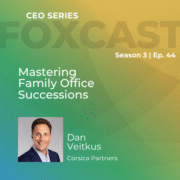
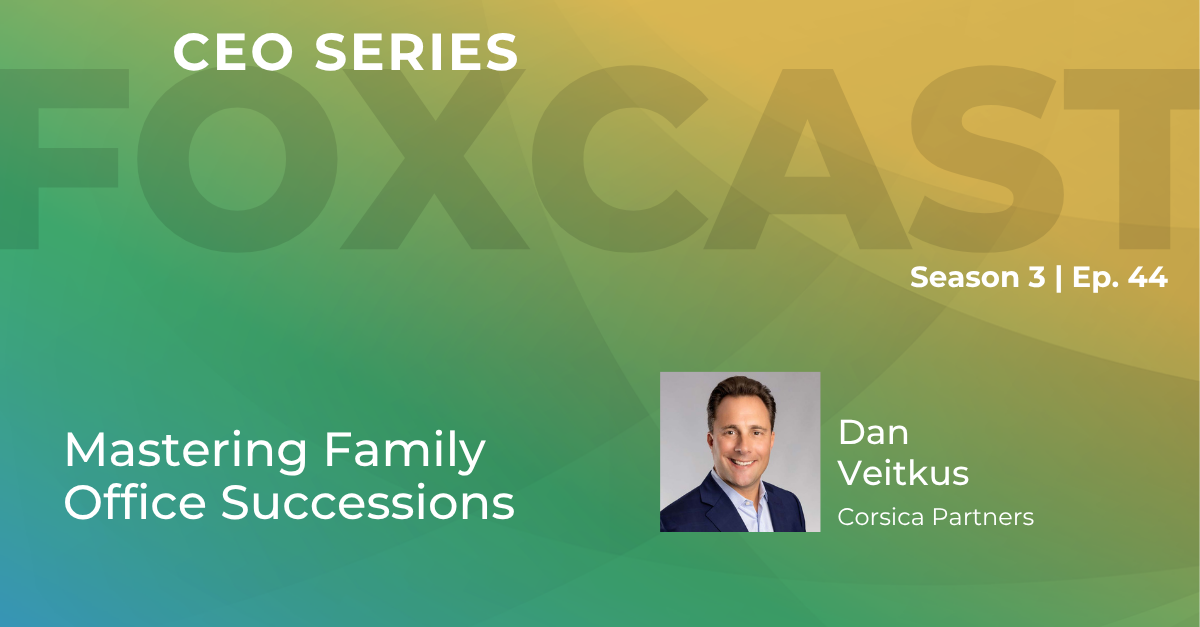
FOXCAST CEO Series welcomes Dan Veitkus, CEO & Managing Partner of Corsica Partners, LLC


Today, I am delighted to welcome Dan Veitkus, CEO & Managing Partner of Corsica Partners, LLC, a global executive search and strategic talent management firm specializing in recruiting executive leadership for private equity, venture and family office backed companies. Dan grew up in a family business and started his first company at the age of 13. Prior to entering the field of executive search and coaching, he served 20+ years as a business leader and executive for private and public companies ranging in size from $10M – $1B annual turnover in the telecom, software/SaaS and corporate learning sectors.

Dan is an active advisor to CEOs and boards and a former distinguished mentor & executive coach for the Branson Centre of Entrepreneurship, an organization founded by Richard Branson to support entrepreneurs by providing leadership development, mentoring and coaching to help launch and grow their businesses. Dan is the author of the Amazon Best Seller Straight Talk Your Way to Success. He also produced a Broadway Show, Dream Big: The Rudy Ruettiger Story, now available on Amazon Prime.

Succession is easily one of the top three evergreen topics and challenges that UHNW families and their family offices contend with all the time. Dan explains why it is important that succession happens in the family office in a planful and smooth way. He highlights how succession in the family office is different from traditional corporate succession and business continuity practices and points out the unique distinctions of family office transitions and successions.

Based on his extensive experience advising and recruiting talent for family offices, Dan offers his practical suggestions for family offices and family principals looking to hire key executive talent as part of their succession planning.

He also offers practical tips for all the other stakeholders in the succession process, including the candidates looking to land the key role at a family office, but also the advisors, family office employees, and family members who participate in or are impacted by the leadership transition.

Enjoy this insightful conversation with a leading talent and operations practitioner and advisor in the UHNW and family office space.

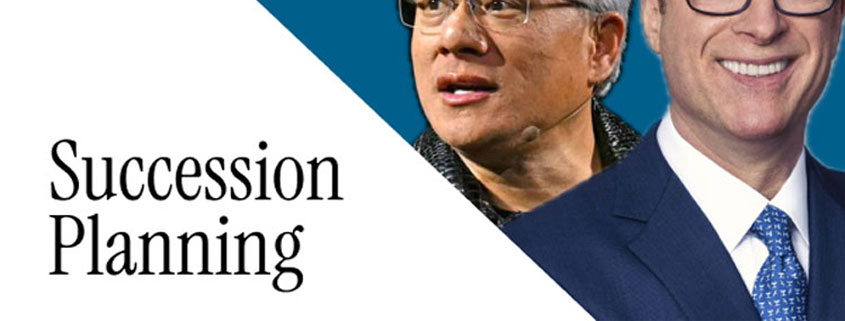
A well-developed succession plan forces you to confront brutal truths…

Jensen Huang is certain “NVIDIA will outlive us all.”

Not, “I’m working on finding a replacement.”

Not, “We have a succession committee.”

A declaration of organizational immortality.

Meanwhile, Brad Jacobs has built eight billion-dollar companies. United Waste. United Rentals. XPO and its spinoffs.

Every single one designed from day one to thrive without him.

Same principle. Radically different execution.

Jensen’s been CEO of NVIDIA for 31 years. One company. One mission. One lifetime commitment. His succession plan? Build systems so deep that no single person matters. Including him.

40+ direct reports. No hierarchical bottlenecks. Every division runs independently. Information flows everywhere, not through him.

The company doesn’t need Jensen. The company IS Jensen. His thinking embedded in every process, every hire, every decision framework.

Brad takes the opposite path. Eight companies in 40 years. Each one built, scaled, and transitioned. $15+ billion in value created across ventures.

His succession plan starts on day one. Before buying or building any company, he identifies who could run it without him. At XPO, he developed Mario Harik for years before handing over the CEO role. The company kept thriving after he left.

Brad builds companies FOR buyers and shareholders, not for founders.

Jensen builds a company that needs NO buyer because it will never be sold.

Here’s what most founders get wrong:

They think succession planning means finding someone like them.

Jensen and Brad know better. Succession isn’t about replacement. It’s about self-reliance; making the company self-reliant. Make yourself unnecessary from the start.

The harsh truth every founder must face: If your company needs you, you haven’t built a company. You’ve built a job.

Jensen made NVIDIA need his thinking, not his presence. Every senior leader can step into another’s role. Every system operates without central command. He once told his team: “If a bus hits me tomorrow, don’t even pause the product roadmap.”

Brad made his companies need systems, not him. Processes over personality. Frameworks over founders. Scale over saviors. Before selling United Waste for $2.5 billion, multiple executives could run any division. The buyer got a machine, not a dependency.

Two paths. One destination: Organizations that outlast their creators.

But here’s the real succession secret Jensen and Brad both mastered:

The plan comes before the person. Not “Who can replace me?” but “What must the next era accomplish?”

A well-developed succession plan forces you to confront brutal truths:

→ The gaps in your current leadership team

→ The concerns that keep you up at night

→ The opportunities you’re missing because of your blind spots

→ The possibilities that only fresh eyes can see

Most founders start with the candidate. That’s backwards.

Start with crystal clarity on what must be accomplished under the next term of leadership.

What does the business need to achieve in the next 5 years? 10 years? What capabilities must the next leader possess? What cultural shifts must occur?

Only then do you pursue the ideal fit with relentless focus.

Not the most convenient choice. Not the longest-tenured executive. Not your favorite. The ideal fit for the plan.

I always coach leaders – build the plan first, then find the person who can execute it.

Because succession without a clear plan is just replacement.

And replacement without the ideal candidate is just hope.

And hope is not a strategy.

Your move.

Executive Hiring Tightens Now, Sets Stage for Selective Rebound in 2026

Executive hiring is entering a new era — one defined by precision, discipline, and measurable impact rather than headcount growth. Dan Veitkus of Corsica Partners says boards and CEOs are now prioritizing “must-have” leadership roles tied to transformation, growth, and value creation. Mr. Veitkus joins Hunt Scanlon Media to discuss the shift from expansion to precision hiring, how market forces are reshaping executive search, and what trends are defining leadership demand heading into 2026.

November 1, 2025 – After a period of aggressive talent expansion fueled by post-pandemic recovery and capital liquidity, executive hiring is entering a new phase — one defined less by growth at any cost and more by targeted investment. Boards and CEOs are recalibrating leadership priorities, emphasizing profitability, transformation, and resilience over pure headcount expansion. The mindset has shifted from “who can we add?” to “what capability do we truly need right now?” This evolution is changing not just who gets hired, but how and when those decisions are made.

Across industries, we’re seeing a sharper focus on precision, alignment, and measurable value creation. Executive search mandates increasingly originate from clear business inflection points — digital transformation, margin compression, succession planning, or restructuring. The result: hiring remains active, but more deliberate. Firms are making fewer, more strategic appointments, expecting leaders to deliver immediate impact under tighter scrutiny and shorter timeframes.

“What I’m seeing is a move from expansion hiring to precision hiring at the executive level,” said Dan Veitkus, managing partner and CEO of Corsica Partners. “Boards and CEOs are narrowing mandates — fewer across-the-board C-suite additions, more “must-have” roles in transformation, growth, turnaround, or new strategic bets.”

Among public companies, hiring is more measured: succession, digital, ESG, or cost-optimization leaders lead the list, according to Mr. Veitkus. “In private equity backed firms, you’ll see compressed hiring windows tied to deal cycles — more active in the post-close value creation period,” he said. “For venture-backed companies (especially early to growth stage), the shift is toward fractional or interim executives, or using venture operators rather than full-time hires until scale justifies it. Across all sectors, I’m seeing increased use of stretch roles (e.g. a head of operations who also leads digital transformation), stronger alignment of executive mandates to financial metrics, and more rigorous fit and runway criteria.”

In short, Mr. Veitkus explained that executive hiring is alive, but it happens on tighter timelines and under greater scrutiny than in past cycles. “We’re now placing discipline ahead of volume in executive hiring,” he said. “For PE deals, the executive search window is a leading signal — not a lagging one.”

Related: Executive Search 2025: Balancing AI Innovation with a Human Touch

So what is causing this? “It’s a confluence of macro headwinds, internal pressures, and evolving expectations — especially at the C-level,” said Mr. Veitkus. He noted that a few of the strongest forces include:

  • Capital discipline and margin pressure — Boards demand returns; adding executives is not a cost you can absorb lightly.
  • Risk asymmetry in leadership — A mis-hire at the executive level carries outsized reputational and financial risk, so the selection bar is higher.
  • Investor scrutiny and activism — Private equity sponsors want executives who can deliver value quickly; public shareholders demand governance, ESG, and performance signals.
  • Talent scarcity and upskilling gaps — Deep domain, cross-industry, or transformation-capable executives are thin. The market for “fit + future-readiness” is narrow.
  • Expectation of speed and accountability — They are expected to shorten time-to-impact in 12 to 18 months or risk replacement.
  • Alternative models (fractional / gig / interim leadership) — Especially in VC and smaller PE platforms, there’s less willingness to commit before the business proves scale.

“A telling data point: PE deals have become more operationally intense — and that drives demand for executives who can hit the ground running in post-close value creation,” Mr. Veitkus said. “And in VC, there’s growing acceptance of fractional models for CFOs, COOs, etc., to preserve capital while testing the leadership fit.”


Dan VeitkusDan Veitkus is managing partner and CEO of Corsica Partners a global executive search, recruitment process outsourcing (RPO) and growth advisory firm. The firm works with global, leading private equity firms, portfolio companies and recognized F500 brands to recruit senior talent, evaluate and develop high-potential individuals and scale growth companies effectively and efficiently. Corsica Partners’ search expertise extends from the boardroom to the back office, encompassing critical roles in the C-Suite to building and scaling across business functions, including sales, marketing, finance, human resources, engineering and product teams. The firm has placed over 4,000 professionals in technology product and services companies, including software, SaaS, PaaS, cloud services, robotics, consumer, semiconductor, healthcare IT, supply chain, AI, machine learning and blockchain.


“So, the cautious approach is not inertia — it’s a new maturity in how C-suite investment is evaluated,” Mr. Veitkus continued. “In executive search today, the upside must justify the risk — or the seat stays empty. Investor discipline now vetoes speculative executive hiring. And fractional leadership is not a stopgap — it’s a strategic option in early-stage deals.”

Near-Term Outlook

Mr. Veitkus’ baseline view is to expect a subdued Q4 with selective upticks in sectors tied to digital, AI, sustainability, M&A, and restructuring — especially in public and PE portfolios. “Into 2026, I lean toward a deliberate rebound in executive hiring, but one stratified by firm strength, sector, geography, and willingness to accept deployment timing risk,” he said.

“A few leadership mandates will resume — especially where delayed transitions, retirements or strategic pivots are unavoidable,” Mr. Veitkus said. “Firms with clean balance sheets (public or PE-backed) will lead. Boards will double down on executive mandates framed as value drivers (AI and digital transformations, growth, M&A, digital). Some backfill roles in transformation, innovation, ESG will slip through.

Looking to 2026

“I expect more confidence if macro cues soften (rate cuts, stabilized inflation, stronger growth),” Mr. Veitkus continued. “The most aggressive hiring, however, will likely be in sectors where disruption is accelerating: AI/ML, renewables, health tech, advanced manufacturing, supply chain. PE-backed platforms that have raised new funds will resume executive buildouts, particularly in commercial, operating and go-to-market leadership. Executive search itself may see an uptick in deal activity and consolidation — search firms betting on a rebound as cited by you, Hunt Scanlon.”

“That said, downside risks remain: a macro shock, renewed credit stress, or prolonged geopolitical disruption could derail confidence and slow hiring,” Mr. Veitkus stressed. “ The fourth quarter will be one where select executive mandates break through — but it won’t be a hiring wave. 2026 will be the year executive hiring reclaims momentum — but only for the prepared and differentiated.”

“Leaders who adapt now — in mindset, metrics, and managerial agility — will win the first leap upward when the cycle turns,” said Mr. Veitkus. “I also believe continued consolidation in our industry will result in clients continuing to gravitate towards the differentiation that boutique firms offer – with preference for personalized, meaningful and senior partner engagement over large conglomerates where search is no longer the core business or where size makes clients feel like just one of many.”

Related: Global Employers Take Cautious Approach to Q4 Hiring

Contributed by Scott A. Scanlon, Editor-in-Chief and Dale M. Zupsansky, Executive Editor  – Hunt Scanlon Media

AI Talent The Continuum

In private equity, the game is to solve things. To acquire. To optimize. To professionalize. To exit.

But when it comes to AI, that word — “solve” — belongs in quotes.

Because AI isn’t a problem you fix. It’s a capability you continuously evolve.

The equation keeps changing: data shifts, models drift, tools multiply, and what was cutting-edge six months ago is suddenly table stakes.

So the real question becomes:

How do PE firms and their portfolio companies “solve” for AI talent when the variables are constantly in motion?

The AI Talent Continuum

When you strip away the noise, success with AI comes down to three interconnected roles: The Strategist > The Operator > The Tactician

Each plays a vital part. Each is incomplete without the others. And knowing which one you need right now is the difference between a flashy pilot and a scalable capability.

1. The AI Strategist – Charting the Course

The Strategist sits closest to the boardroom. They’re masters at connecting the dots between investor expectations, business needs, and technology opportunity.

This is the role that plays beautifully at board meetings as they layout the AI roadmap. The narrative sings. The vision inspires. Everyone leaves the room nodding in agreement that “AI is a priority.”

But as we all know… A plan without execution is just the Dallas Cowboys for the last three decades.

So after the decks are polished, the key question emerges:

Who will actually do the work? Build vs buy? Internal vs outsourced? What capabilities do we really need in-house?

2. The AI Operator – Bridging Vision and Action

The Operator is the translator — the connective tissue between big vision and practical execution.

They know how to turn “AI roadmap” slides into working systems and repeatable processes. They’re allergic to hype and obsessed with outcomes.

The Operator asks:

Does this initiative move the margin or the mission?

Do we have the right data foundation to scale?

How do we embed AI into workflows, not bolt it on?

They’re pragmatic, commercially-minded, and fluent in both SQL and EBITDA.

This is the quiet leader who actually makes transformation stick.

3. The AI Tactician – Building the Future, Line by Line

These are your builders — data scientists, ML engineers, prompt architects, AI product developers.

They’re happiest with hands on the keyboard, bringing new models and tools to life. They’re curious, creative, and fast.

But sometimes… they’re solving the wrong problem beautifully.

Without the Operator’s guidance and Strategist’s context, even the most elegant model can turn into a science project instead of a business advantage.

When aligned, though? They’re the engine that turns ideas into IP, prototypes into products, and roadmaps into enterprise value.

Putting It Together: The Private Equity Lens

For PE firms and portfolio companies, the challenge isn’t whether to invest in AI talent — it’s how and when.

Each stage of maturity demands a different blend:

Early Stage / Carve-Out: Start with a Strategist to map the AI opportunity.

Growth Stage: Layer in Operators who can operationalize pilots and wins.

Scale Stage: Build your internal AI capability while partnering externally for speed.

The mistake? Hiring a single “Head of AI” and expecting them to do all three jobs. That’s not a strategy — that’s a setup.

Culture Is the Force Multiplier

The best portfolio companies don’t just add data scientists — they create a culture that allows AI to thrive.

They democratize data. Reward curiosity. Celebrate progress over perfection.

Because AI transformation isn’t just about skillsets — it’s about mindsets. Shift the paradigm.

The Takeaway

AI isn’t something you install — it’s something you become.

It takes: The Strategist to define the why; The Operator to drive the how; The Tactician to make it real.

Each role evolves. Each is essential. And the art is knowing which to emphasize — and when.

The Call to Action

If you’re a PE partner evaluating AI maturity across your portfolio, or an operator translating AI ambition into execution — it starts with people, not platforms.

At Corsica Partners, we help investors and executives build the teams that turn AI theory into enterprise advantage.

Let’s connect and map where your organization sits on the AI Talent Continuum — and what it takes to move from vision to value.

The Blindfold

The same brilliance that builds billion-dollar companies destroys them.

It’s not incompetence. It’s not simply arrogance. It’s a twisted bi-product of success itself.

Watch the pattern that killed billion-dollar empires.

These leaders didn’t lose their intelligence. Success replaced their curiosity with certainty.

1997: Blockbuster has 6,470 stores, $3.91 billion in revenue, and 12 years of experience. Netflix is tiny and unproven.

But Blockbuster CEO, John Antioco, was blinded by success.

Fast forward 13 years, Blockbuster goes bust — audiences demand more Netflix.

1998: Yahoo refuses to buy Google for $1 million. CEO Tim Koogle built Yahoo from startup to $125 billion through complex thinking and deep curiosity.

But success whispered: “Humans curate better than algorithms.”

Google’s algorithm ate them alive.

2000: MySpace dominates social media. 115 million users. Their founders, Chris DeWolfe and Tom Anderson, built it from nothing through curiosity and critical thinking.

But success taught them the wrong lesson: “Customization is king.”

Facebook won with simplicity they couldn’t see.

2007: Nokia controls 40% of phones. CEO Jorma Ollila was Europe’s most celebrated executive. He transformed Nokia from paper mills to mobile phones through raw cognitive horsepower.

But success convinced him: “Hardware excellence wins.”

iPhone destroyed them with an app store.

BlackBerry’s Mike Lazaridis: Built the company through obsessive curiosity about mobile email. Died believing physical keyboards were sacred.

See the transformation?

Every single leader STARTED with:

Cognitive horsepower — Processing complex problems

Critical thinking — Questioning everything

Deep curiosity — Hunger to learn

Complex model building — Understanding how systems work

That’s HOW they built billion-dollar companies.

But then success performed a magic trick…

It replaced their critical thinking skills with overreliance on the patterns of their past success.

Their curiosity became certainty.

Their questions became irrefutable answers.

I call this The Attenuation Factor: The gradual loss in force, effect, value or relevance of one’s experience as conditions change.

When you succeed, your brain locks in the pattern. “This worked, so this is how things work.”

You stop thinking critically because… why would you?

You built a $6 billion company. You must know something.

But here’s the killer:

Your success came from foundational attributes that never expire.

Your failure comes from pattern recognition that expires in 18 months.

Let’s take John Antioco as an example:

Antioco at Circle K: No answers, just grit and critical thinking. He turned it around from bankruptcy to a $425M sale in 2 years.

Antioco at Taco Bell: Pure critical thinking and managing complexity. “What if fast food could be… faster?” In just 8 months, he reversed the 18-month streak of declining sales.

Antioco at Blockbuster: Pure pattern recognition. “Late fees work because they’ve always worked.”

Same person. Same intelligence.

Wrong mindset.

This is happening to you right now ↓

Think about your biggest win.

– What patterns did you extract from it?

– What “lessons” did you learn?

– What “truths” do you now believe?

Those patterns are already decaying.

Because the leaders that embrace disruption thrive!

Reed Hastings. Jeff Bezos. Satya Nadella.

They had the same early success as Antioco — but it didn’t blind them.

Hastings, Bezos, Nadella — they did something different:

They treated success as data, not doctrine.

They kept their foundational attributes active:

Still questioning despite being proven right

Still curious despite knowing their industry

Still thinking despite having working patterns

They understood something brutal:

Success is the enemy of critical thinking.

The more you win, the less you question.

The less you question, the more you trust patterns.

The more you trust patterns, the closer you get to death.

Because certainty is the antithesis of growth.

Satya Nadella at Microsoft: “Be a learn-it-all, not a know-it-all.”

Jeff Bezos at Amazon: “Day 2 is stasis, followed by irrelevance, followed by death.”

Reed Hastings at Netflix: “We have to destroy our own business before someone else does.”

They protected their beginner’s mind despite their expert success.

The Attenuation Factor is a silent killer. AI will multiply the casualties.

The remedy:

1) The Quarterly Unlearning

Pick your strongest belief about your business.

Spend a full week trying to destroy it.

Can’t find flaws? You’re already dying.

2) The Anti-Perfect Resume Hire

Your next senior role: Zero industry experience required.

Just raw cognitive horsepower and a raging level of curiosity.

Hungry. Humble. Core Values Aligned. Fresh Perspective.

Veterans bring patterns. Rookies bring possibilities.

3) The Competitor Test

“If I was starting from scratch against myself, how would I win?”

Weak answer? You’re vulnerable.

No answer? Find a tombstone.

4) The 18-Month Expiration

Strategies older than 18 months: Prove they still work

Beliefs older than 3 years: Burn them down and rebuild

Success stories older than 5 years: Cautiously remember them. Be cognizant of which beliefs they’re still shaping within you. Likely, it’s time for an update.

The moment you trust your experience more than your curiosity, the clock starts ticking.

The saddest part about Blockbuster?

Antioco had the cognitive horsepower to see Netflix coming.

He just traded it for pattern recognition.

He had the critical thinking to adapt.

He just trusted his patterns more.

Your confidence in pattern recognition will kill you the same way.

Unless you choose curiosity over certainty.

Questions over answers.

Thinking over remembering.

The moment you stop thinking like a beginner, you start dying like an expert.

Because in the end, most companies die embracing what success used to look like;

Death comes when you let success blindfold you.

The blindfold has a name: The Attenuation Factor