


Corsica Partners
Q2 2026 | Talent Insights and Perspective
The Corsica Partners’ Quarterly Brief brings together timely insights for executives, investors, and boards navigating growth, transformation, and talent acquisition and retention priorities.
This brief is prepared for our clients, candidates and business partners and it reflects what we are seeing, hearing, and learning from the highest-performing companies, most admired leaders, and most successful financial sponsors across the market.
Each edition distills those observations into concise perspectives on the leadership and talent dynamics that are defining competitive advantage right now. We share these insights in the spirit in which they are offered, as trusted advisors committed to the success of the leaders and organizations, we are proud to serve.
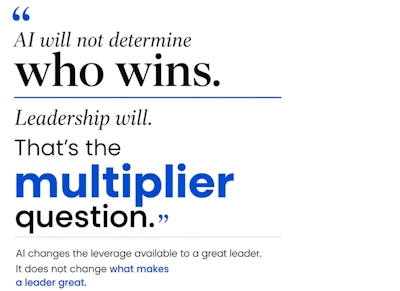
The conversation about AI and the future of work has reached peak noise. Competing headlines tell us everything and nothing at once: AI creates abundance; AI eliminates jobs; AI is overhyped; AI is underestimated. All of them, in their own way, are correct. But for the leaders and organizations we serve, the more important question is not what AI does — it is who is equipped to lead through it.
That question has a sharper edge than it appears.
The Structural Shift
Futurist Peter Diamandis has written compellingly about what he calls the “organizational singularity”—the moment when one person paired with AI can execute what once required teams of fifty or one hundred. The transaction costs that made the traditional corporation necessary are collapsing. Functions that required headcount, overhead, and coordination are increasingly automated. Diamandis identifies two emerging classes: orchestrators, who direct AI systems with strategic intent, and the displaced, who wait for structures that no longer exist to carry them forward.
This framing is useful. It is also incomplete because orchestration is not a technology skill. It is a leadership skill. And leadership skills are exactly what our clients are trying to hire, develop, and retain right now.
“AI automates tasks, but building human leadership remains essential for strategy, sound judgment, and creative thinking — capabilities that provide an irreplaceable competitive edge.” ~MCKINSEY & COMPANY
What We Are Seeing
The pace of change continues to accelerate, and even those who believe they are first movers know it takes but a day to fall behind. In that environment, practical experience is at a premium. And where experience is absent, hesitation fills the gap.
We see it in candidates uncertain about what their next role will demand of them — and whether their current capabilities translate. We see it in clients struggling to define what AI-fluent leadership looks like beyond the buzzword, and how to assess it in a search process. And we see it across the search industry itself, navigating an advisory function that is itself being transformed.
Our view is direct: meet talent where they are. Not with hype. Not with alarm. With practical guidance grounded in what we are observing across diverse sectors, and what it is changing about leadership profiles.
The companies positioned to lead their sectors three years from now are building AI capability into every function today. That makes every executive hire a higher-stakes decision than it was in the previous cycle. The leaders hired in this window will either accelerate transformation or become the constraint on it. There is diminishing middle ground.
What Good Looks Like
The capabilities that matter most in this environment are not found on a technology vendor’s feature list. They are profoundly human — and more differentiated than ever precisely because they cannot be replicated at scale.
Critical thinking
Owns their analysis. Resists the pull of consensus and the seduction of easy answers.
Situational awareness
Reads the room — the organization, the market, the moment — and calibrates accordingly.
Systems thinking
Sees second-order effects. Understands how decisions ripple before they act.
Calm amid hype
Neither seduced by possibility nor paralyzed by disruption. Grounded and clear-eyed.
Resolve under uncertainty
Moves forward without full information. Makes the call. Adjusts without ego.
AI fluency
Not mastery of tools — but literacy in possibility and judgment about application.
These are the attributes we are screening for across every engagement. They are also the attributes that will determine whether AI becomes a force multiplier or a drag on enterprise value.
The CP Perspective
We are not in the business of predicting when AI peaks or plateaus. We are in the business of finding the leaders who perform through whatever comes next.
The organizational structures described in the current discourse — leaner, faster, more agentic — are real and they are arriving. But they do not run themselves. They require orchestrators who possess strategic judgment, the capacity for genuine creative synthesis, and the relational trust that neither a language model nor an agent fleet can manufacture.
AI changes the leverage available to a great leader. It does not change what makes someone one.
In a moment defined by noise, the ability to think clearly and act with conviction is the scarcest resource in any organization. That is what we are searching for. It is what we deliver for our clients.
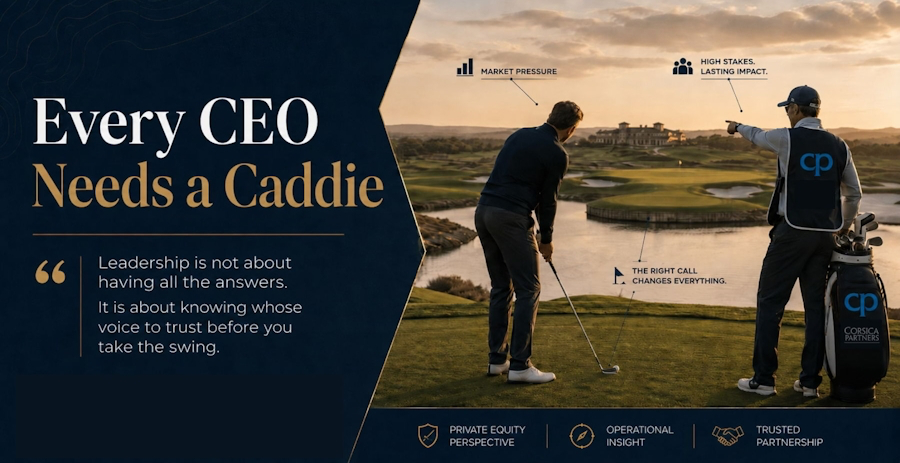
One of the great myths of golf is that it is an individual sport.
Sure, there is only one player holding the club. But spend five minutes watching a major championship and you’ll see the truth: the player may hit the shot, but the caddie is never far from the decision.
They are part strategist, part psychologist, part meteorologist, part truth-teller.
The best caddies know when to encourage, when to challenge, and when to quietly remove the driver from the conversation.
The same is true in business.
A CEO may be the one standing over the ball, but the best ones are rarely operating alone. They have people around them who help read the terrain: board members, investors, operating partners, CFOs, chiefs of staff, and trusted advisors who can see what pressure sometimes distorts.
That matters even more in private equity.
The course is shorter. The expectations are higher. The hazards are everywhere. And nobody wants to explain to the board why they tried to carry the water with a 3-wood when a sensible layup would have done just fine.
Great CEOs need conviction.
But they also need counsel.
They need people who can help them separate confidence from ego, urgency from panic, and boldness from recklessness.
Because leadership is not about having all the answers.
It is about knowing whose voice to trust before you take the swing.

Inna Kuznetsova
Straight Talk from the C-Suite
AI in the Enterprise.
Host: Dan Veitkus, Managing Partner, Corsica Partners
A conversation with Inna Kuznetsova, an award winning, 3x CEO for PE backed, global SaaS and AI companies, recognized as a top Tech CEO and top female executive in the supply chain industry and an active board member for global public and private companies.
Introduction
The discussion around AI in the enterprise has moved well past strategy decks and board presentations. It is now reshaping how executives lead, how organizations hire, and how the most forward-thinking companies are defining leadership itself. In this edition of our Straight Talk from the C-Suite series, I sat down with Inna Kuznetsova, a C-suite leader who is navigating that transformation from the front lines, bringing her perspective on what AI means for her work, her team, and the talent decisions that will define the next chapter of her organization. This conversation touched on leadership in the age of intelligent machines, and what it takes to be irreplaceably human.
AI & Personal Work Patterns
Walk me through a typical week — where has AI genuinely changed how you personally work, and where do you still insist on human judgment above all else?
AI has compressed the time I spend on synthesis, research, and first-draft work. But I keep human judgment for prioritization, tradeoffs, even the tone of communications for each particular case.
What’s the most unexpected way AI has shown up in your personal workflow in the last year — something that would have surprised even your 2025 self?
As a non-work example, I set an agent to distill news from dozens of news sites in multiple languages, foes and allies, on Iran war to just facts and numbers, while removing the political opinions. So, getting up to speed in a more objective way took just seconds every morning. A more refined way of AI use was writing an application allowing me to add comments to networking records, and this is by someone who has not coded since Harry met Sally.
AI Shaping the Operating Environment
Private equity investors and board-level stakeholders are watching how leadership teams operationalize AI — what does ‘getting it right’ actually look like inside your organization, in concrete terms?
Teams that win treat AI as process redesign, not a tool rollout. I am very supportive of spending a bit on experiments, allowing everyone in the organization to test what they can do and come up with solutions. People who are the closest to the workflow, e.g. implementation team spending hours on data quality or setting customer’s analytics process often come up with the most practical ways to cut time. However, when it comes to a full organizational rollout the measurable productivity gain in core workflows, and controlled risk through clear policies on data, validation, and human checkpoints are important.
Testing for AI Acumen in Executive Recruiting
When you’re evaluating a C-suite or senior leadership candidate, how do you distinguish between someone who genuinely understands and applies AI versus someone who has simply learned to speak the language?
I ask them to walk me through a specific problem they solved differently because of AI no matter how small. People who actually use it can get granular immediately; people who’ve learned the language tend to stay abstract and pivot to strategy. If you vibed a small app or ran a company valuation model together with research on multiples, you will be able to answer the clarifying questions, that is what you did not like in the first draft and how you corrected it.
The Human Value Proposition
As AI assumes more of the cognitive load, what uniquely human qualities are you doubling down on — in yourself, and in the leaders, you recruit and develop?
People who are successful in the AI era think as architects, not coders. I double down on why a certain problem was selected, check for judgment under ambiguity, taste, and accountability. AI makes us leaders before we are ready to lead. So, I look for the ability to frame problems well, set a high-quality bar, approach the answers critically and align people around actions.
What is the one quality you’ve observed in your highest-performing leaders that no AI tool has come close to replicating — and how do you deliberately screen for it when building your team?
Initiative, sound judgment, ownership of hard decisions, and honest reflection are among the most valuable human leadership traits. I look for leaders who can tell me about a moment when they surprised others with a thoughtful strategic move, as well as a time when they looked back on a successful project and still saw a better way it could have been done. Self-awareness is uniquely human and an attribute I prioritize when vetting candidates.
Outlook for the Balance of 2026
If you could prompt your peers in the C-suite right now, something you wish more leaders were paying attention to heading into the back half of the year, what would it be?
Buying Copilot licenses is not an AI strategy. Take one proven use case an employee is already doing and scale it across the function quickly; start small, move fast, because the market is not waiting.
Straight Talk Summary
AI acumen is a required leadership attribute, and the most successful leaders are learning, challenging, recalibrating and pressing forward in real time.
At Corsica Partners, we see this dynamic every day. The organizations pulling ahead are not simply adopting AI tools. They are asking harder questions about the humans deploying them — their judgment, their adaptability, and their capacity to lead through ambiguity without losing their footing.
What distinguishes the executives we most respect — and most frequently place — is not their fluency with technology alone. It is their clarity of thought, their integrity under pressure, and their instinct for what matters when everything is moving at once. Those qualities do not appear on a dashboard. They reveal themselves in the decisions leaders make when the stakes are real.
That is the conversation Corsica Partners is built to facilitate — with investors, boards, and executives who understand that exceptional talent remains the most durable competitive advantage in any market, in any cycle.
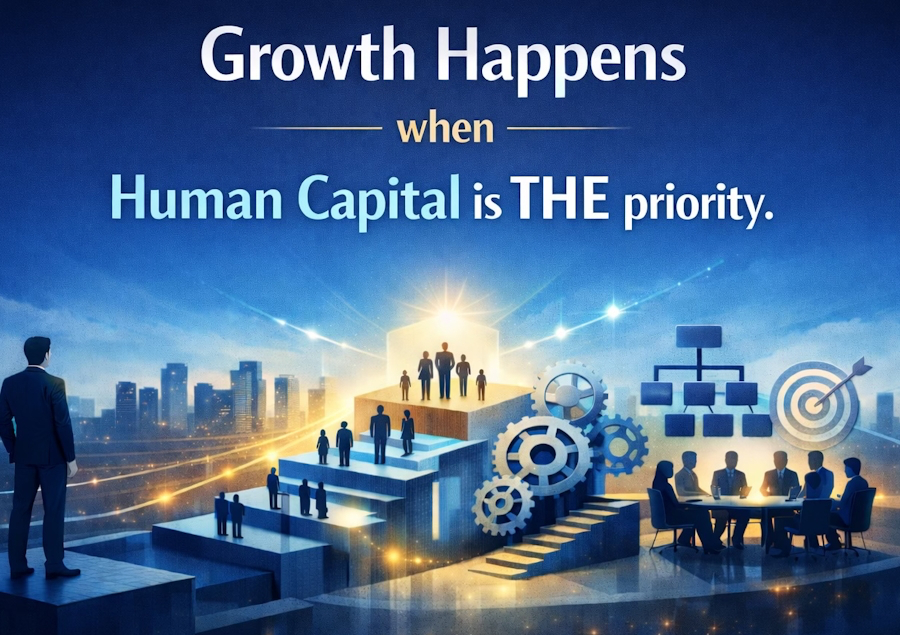
Across a diverse set of industries, we note the same advantage present in the companies that sustain profitable growth:
They treat people and leadership the way they treat product, finance, and go-to-market—by building a scalable architecture, not just hiring more people.
While many companies upgrade their tech stacks before they upgrade leadership infrastructure, top performing firms prioritize both in tandem.
What breaks down at $25M, $100M, $500M & >$1B is rarely market fit. It’s the operating cadence and leadership depth.
The through-line is clear:
Sustained growth requires continuity and discipline and those come from intentional systems for talent and leadership.
Think of this as your Human Capital Architecture: the evolving set of practices that ensures you can attract, develop, deploy, and retain leadership capacity as the business scales.
Boards and CEOs should be asking themselves these questions and reviewing the answers quarterly:
- Will our talent and leadership systems keep pace with the business—or are we expecting yesterday’s model to carry tomorrow’s complexity?
- Is our leadership bench compounding or thinning?
And if they are sponsors of founder-led businesses, face reality. If the CEO is still the operating system, the company will not scale according to your thesis.
Take this experience to heart:
The most expensive scaling mistake isn’t a bad hire—it’s having no bench.
Profitable growth doesn’t break because of strategy. It breaks because leadership capacity doesn’t scale.
At every stage of growth, the constraint is the same: leadership competency and capacity.
And growth continuity isn’t luck. It’s designed—and executed through a disciplined Human Capital Architecture.

- CEO, private equity backed, managed IT services
- CEO, privately held, AI powered SaaS, analytics & logistics
- President, private equity backed, wealth management company
- CFO, private equity backed, SaaS company
- Head of AI, privately held, multi-site healthcare services provider
- Head of AI, family office, HoldCo
- CCO, private equity backed, life sciences company
- SVP Sales, private equity backed, biotech company
- Chief Product Officer (CPO), privately held, GRC SaaS platform
- Non-Executive Board Member, life sciences company
Experience the Corsica Advantage™
Corsica Partners serves as a trusted, boutique executive search firm to discerning investors, their portfolio of companies and leading public companies across technology, tech-enabled services, healthcare and life sciences.
We offer the following services to clients:
* Retained, Executive Search
* C-Suite Talent Pipeline Development
* Executive Coaching and Growth Advisory Services
Whether your profile is early stage, high growth, turnaround or you’re at the crossroads of a transformation or you simply desire to experience a better executive search and coaching outcome, we invite you to put the Corsica Advantage™ to work for you.
For more information, please contact us at info@corsicateam.com or +1.941.444.9617

